
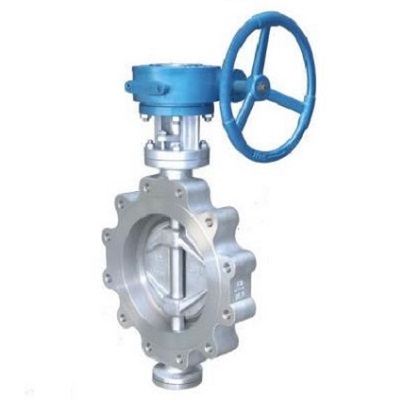
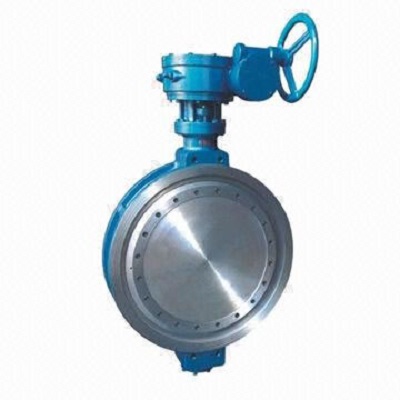
Double Offset Butterfly Valve
& Free Shipping
Size: DN50~DN2000
Pressure:Class150-600LB or PN16-PN64
Material:AL-Bronze, WCB, CF8, CF8M, CF3, CF3M etc.
Design & Manufacture Std.:API609, MSS SP-67, MSS SP-68, DIN3354
Free shipping on orders over $50!
- Satisfaction Guaranteed
- No Hassle Refunds
- Secure Payments
Description
A butterfly valve is a valve which can be used for isolating or regulating flow. The closing mechanism takes the form of a disk. Operation is similar to that of a ball valve, which allows for quick shut off. Butterfly valves are generally favored because they are lower in cost to other valve designs as well as being lighter in weight, meaning less support is required.
A butterfly valve is from a family of valves called quarter-turn valves. In operation, the valve is fully open or closed when the disc is rotated a quarter turn. The “butterfly” is a metal disc mounted on a rod. When the valve is closed, the disc is turned so that it completely blocks off the passageway. When the valve is fully open, the disc is rotated a quarter turn so that it allows an almost unrestricted passage of the fluid. The valve may also be opened incrementally to throttle flow.
There are different kinds of butterfly valves, each adapted for different pressures and different usage. The zero offset butterfly valve, which uses the flexibility of rubber, has the lowest pressure rating. The high performance double offset butterfly valve, used in slightly higher-pressure systems, is offset from the centre line of the disc seat and body seal (offset one), and the centre line of the bore (offset two). This creates a cam action during operation to lift the seat out of the seal resulting in less friction than is created in the zero offset design and decreases its tendency to wear. The valve best suited for high-pressure systems is the triple offset butterfly valve. In this valve the disc seat contact axis is offset, which acts to virtually eliminate sliding contact between disc and seat. In the case of triple offset valves the seat is made of metal so that it can be machined such as to achieve a bubble tight shut-off when in contact with the disc.
Lug-style valves have threaded inserts at both sides of the valve body. This allows them to be installed into a system using two sets of bolts and no nuts. The valve is installed between two flanges using a separate set of bolts for each flange. This setup permits either side of the piping system to be disconnected without disturbing the other side.
A lug-style butterfly valve used in dead end service generally has a reduced pressure rating. For example a lug-style butterfly valve mounted between two flanges has a 150 psi pressure rating. The same valve mounted with one flange, in dead end service, has a 75 psi rating.
Technical Specifications
| Design & Manufacturer | Face-to-Face | Flange Dimensions | Test & Inspection |
| API | ANSI B16.10-2002 | ANSI16.5-2004 | API598-2004 |
Test Pressure
| Nominal Diamater DN(mm) |
830W | 830L | |
| 2″-36″ | 2″-36″ | ||
| Nominal Pressure PN(lb) | 150 | 300 | |
| Test Pressure (Mpa) | Shell test | 3 | 7.5 |
| Sealing test | 2.2 | 5.5 | |
| Suitable Medium | water, steam, oil, sea water, etc | ||
| Applicable Temperature | -29ºC~36ºC | ||
Main Parts & Materials
| Part Name | Material |
| Body | WCB,304,316,316SS,CF8M |
| Disc | WCB,304,316,316SS,CF8M |
| Stem | 316,2Cr13,1Cr18Ni9Ti |
| Seat Ring | 316, PTFE |
| Packing | Soft graphite, PTFE |
Reviews
There are no reviews yet.